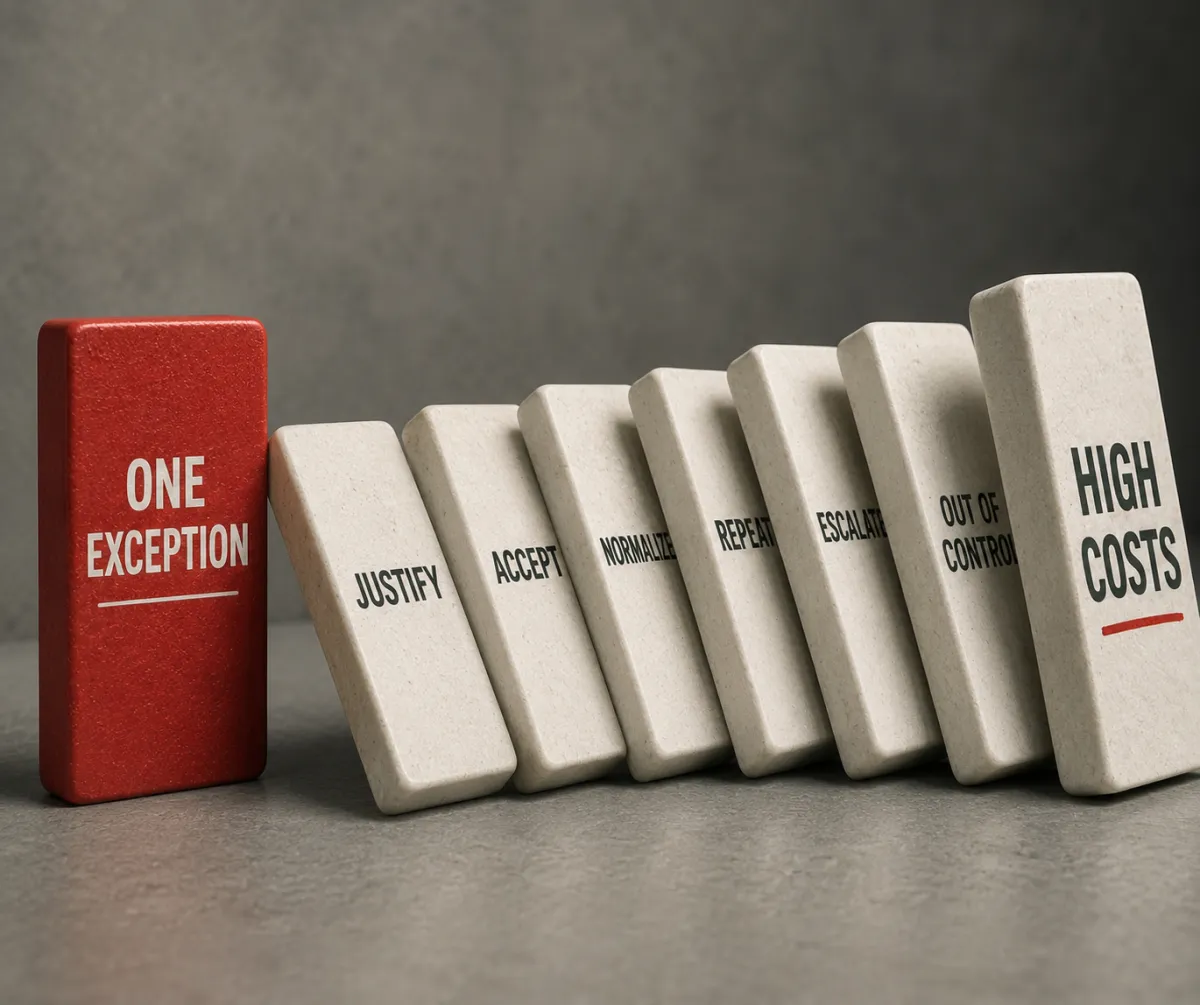
The Cost of Letting One Exception Slide
A single exception rarely feels like a major leadership failure in the moment. A leader extends a deadline because an employee is dealing with personal stress. A top performer violates a behavioral expectation and leadership avoids the conversation because that person generates significant revenue. A team member ignores an established process and leadership decides addressing it feels unnecessary for a single mistake. In each situation, the decision often feels practical, compassionate, and easy to justify.
What leaders often fail to recognize is that employees rarely interpret exceptions as isolated decisions. They view them as signals that reveal how accountability actually functions inside the organization. Teams constantly observe what leadership enforces, what leadership ignores, and where standards begin to bend. Employees notice when one person misses deadlines without consequences, when certain individuals receive flexibility others would never receive, and when policies appear firm until enforcing them becomes uncomfortable.
Those observations begin shaping workplace behavior much faster than many leaders realize. High performers are often the first to feel the consequences of inconsistent accountability because they consistently meet expectations, maintain professionalism, and frequently carry a disproportionate amount of responsibility. When they watch lower-performing employees receive repeated exceptions without meaningful consequences, frustration begins building quickly because leadership appears unwilling to protect the standards they work hard to maintain.
Some high performers eventually lower their own standards because consistency no longer feels rewarded. Others become emotionally disengaged and stop investing discretionary effort into the organization. Many leave entirely because they no longer trust leadership fairness. Leaders frequently misdiagnose these departures as compensation issues, burnout, or career growth concerns while overlooking the resentment created by selective accountability.
Lower-performing employees often interpret exceptions very differently. When they see one exception go unaddressed, they begin testing where additional flexibility exists. Deadlines begin feeling softer, behavioral expectations start feeling negotiable, and excuses become more frequent because employees have already seen leadership retreat from accountability before. Over time, what began as a single exception can quietly reshape cultural expectations across an entire team.
I worked with a leader who repeatedly protected a high-performing salesperson because that individual generated significant revenue for the organization. The employee consistently ignored communication protocols, created unnecessary internal conflict, and regularly violated behavioral expectations. Leadership repeatedly justified avoiding accountability because losing that revenue felt too risky in the short term.
The short-term protection created long-term instability. Other employees became increasingly resentful because they were expected to maintain professionalism while watching someone else operate under an entirely different set of standards. Team trust declined because fairness disappeared. Collaboration weakened because employees stopped trusting leadership consistency. Eventually, multiple strong employees left because they were tired of carrying the emotional and operational burden created by selective accountability.
The organization believed it was protecting revenue, but it was quietly creating a much larger financial problem. Recruiting replacements became expensive. Productivity declined as strong employees disengaged. Internal conflict consumed leadership time. The organization spent months managing issues that could have been prevented through earlier accountability.
This pattern appears in organizations of every size because leaders often confuse empathy with avoidance. They believe enforcing standards firmly will make them appear harsh, inflexible, or disconnected from employee realities. In reality, inconsistent accountability creates far greater damage because employees lose trust in leadership fairness and organizational stability begins eroding.
Strong leaders absolutely make room for legitimate life circumstances. Employees experience personal emergencies, unexpected challenges, and situations that may require temporary flexibility. The difference is that healthy flexibility addresses temporary circumstances without permanently lowering organizational expectations.
Employees need confidence that accountability remains stable. They need to know strong performance does not exempt someone from behavioral expectations. They need to trust that standards apply consistently regardless of title, tenure, revenue production, or personal relationships with leadership.
When leaders repeatedly allow exceptions to avoid discomfort, employees notice. Accountability weakens, trust erodes, and performance eventually follows. Many organizational culture problems do not begin with major leadership failures. They begin with small decisions leaders convince themselves are harmless while underestimating the ripple effect those decisions create.
If you find yourself repeatedly making exceptions, avoiding accountability conversations, or protecting certain employees at the expense of your broader team, there is often a deeper leadership issue underneath it. At heybrenda.com, I help leaders identify these blind spots early, strengthen accountability, and stop small leadership decisions from becoming major organizational problems.
The true cost of letting one exception slide is rarely tied to the original incident. The real cost shows up when your entire team begins believing standards are optional.
